
No One Should Grieve Alone
On the Berlin Pride Attack, Queer Loneliness, and the World We Long to Make
There was nothing ordinary about yesterday’s Sunday afternoon. Almost 10,000 of us had gathered in front of the Brandenburg Gate, Berlin’s symbol of liberation, to mourn the horrific attack of the night before that had violently brought Pride, the Christopher Street Day celebration, to an end. Standing in the crowd, next to my sister and a close friend, we listened to beautiful words, spoken and sung, and unspoken in a minute of shared silence in remembrance of the woman who had lost her life just a few hours prior, and the many who got injured and scarred for a lifetime.
In the eyes that passed me, I saw a deep sadness, a fleeting hopelessness. Heads tilted, hands covering faces, bodies shivering with tears, tired voices calling for resistance. No one should grieve alone. Especially not in a country and a city that is built on layers and layers of grief, guilt, and shame that never broke open collectively, that got suppressed and silenced across generations. A country facing the banality of evil in the ideology of the far-right politics of Alternative für Deutschland (AfD), under a government whose queer solidarity mostly amounts to lip service.
As I write this on Monday midday, we don’t yet have the exact details of the attacker’s motive, though authorities are currently treating this as an act of terror. He’s since been caught and shot by police, a German-born man of Lebanese roots, previously known to authorities, who had tried, unsuccessfully, to join IS in Syria, distancing himself from it afterwards. One detail feels worth naming here: research on radicalization keeps finding loneliness underneath both lone-actor terrorism and the pathways that lead people toward groups like IS. That doesn’t explain what happened, and it explains nothing away. But it means the grief we share, and whatever emptied the person who caused it, may share a common root of loneliness, even where what grew from it looks different.
Within hours, before anyone had real facts, speculation was already doing what it always does: Islamist terrorism feeding the far right’s favorite story, and the far right feeding right back into the fear. Both things can be true. That extremist violence, whatever ideology it hides behind, deserves to be named and taken seriously. And that folding an entire religion or an entire migrant population into that verdict is its own act of violence.
What I want to turn towards in this moment is the loneliness of queerness. A loneliness that, ultimately, is a longing for love.
And an attack against love—of any form—is an attack against humanity. That is all of us.


Queerness is not a modern phenomenon.
Across Africa, Asia, Indigenous North America, and the Pacific, there are historical records that often were overwritten by missionaries, colonial administrators, and later nationalist histories that imposed binary gender systems and heterosexual norms—to compartmentalize society into neatly organized categories and clusters, the opposite of queerness, so to speak.
Out of historical and ongoing erasure, depending on what part of the world you are in, concealment and silence follow and fuel queer loneliness.
In certain countries, living openly as queer remains largely impossible, even unthinkable, a structural condition of loneliness for queer people that has nothing to do with what you wear or how openly you express yourself. A world built inherently not for queerness makes liberating oneself, even where networks of solidarity exist, a deeply lonely way of living. The precondition for any of it, simply being able to exist and be safe, is not guaranteed.
I think of a Chinese friend who left the country as soon as he could, an intersex person fighting for rights in the U.S. state of Texas, another one from Azerbaijan who sought exile in Portugal, another from Russia who I know has survived more than one physical violent attack on the streets of Milan. Here’s where we have to ask questions that are more specific than “Where do I belong?” or “Where am I accepted?” to “How do we belong across language, race, nation, family expectation, and displacement?” It’s a longing across multiple words that exceeds the idea of monolithic identity and finding home.
As understood in Indigenous cultures, and queer writing in particular, relationality isn’t bound to identity, but an inherent relationality to land, ancestry, kin, and multispecies. Belonging becomes ecological, historical, and communal, offering a political angle centered on safety, care, and endurance.
This is what Sarah Ahmed calls disorientation: not knowing where you stand because the world has been organized around someone else’s comfort. And crucially, she refuses to treat disorientation as only loss. As she argues, it can also be the opening, the moment the world’s arrangement becomes visible precisely because you are not settled inside it. To live queerly is to have a particular relationship to what is taken for granted. That is a form of loneliness. It is also, potentially, a form of clarity.
Since the Stonewall riots in 1969, the struggle for LGBTQI+ rights has been ongoing, and for many, it has been a lonely one. Yes, because our patriarchal, heteronormative societies have been designed in ways that simply leave no space or equanimity for queerness.
But also, because those of us who see ourselves not as part of “this community” have failed to support and be in solidarity as we might say we are. To be systematically marginalized and operating from the fringes of ever-decreasing budgets and conditions, under governments who might be straight up queerphobic or merely performing progressiveness, is to live out of a sense of abandonment, a brutal kind of loneliness. Of not being seen, accepted, and embraced in your identity as an individual, nor being part of a shared reality altogether. One of the speakers on stage spoke to this: the sheer need for each other beyond moments like these, where the horror is so unbearable that we show up collectively.
“Why must it come to such extremes before we realize we have to act?”, they asked.
Tomorrow, when the news will move on, and we’ll get on with our lives, will we still care? Enough to ponder where each of us can truly live and move from solidarity?
In the same way I see myself in solidarity with men who do the work, I too see myself as an ally with those identifying as queer and part of LGBTQI+. No struggle is separate from another.
When condemning and rallying against an enemy has become the thing we most share—a tragedy in itself—how do we still expand our hearts into our capacity to understand, love, and care for each other, and see the other in us, and ourselves in the other?
“Leave your phone and your bubble, take a trip to where you’d think you’ll meet ‘the other’, and have a chat with them,” said the closing speaker, a trans woman, who grew up in Saxony-Anhalt where the AfD now polls at 41 percent.
As the speakers at the vigil remind us, the woman who lost her life to the attack could have been any one of us. Regardless of sex, identity, background, ethnicity, profession, class, or any of the categories and concepts we’d divide ourselves and each other into.
If one of us is not safe, then no one of us is.
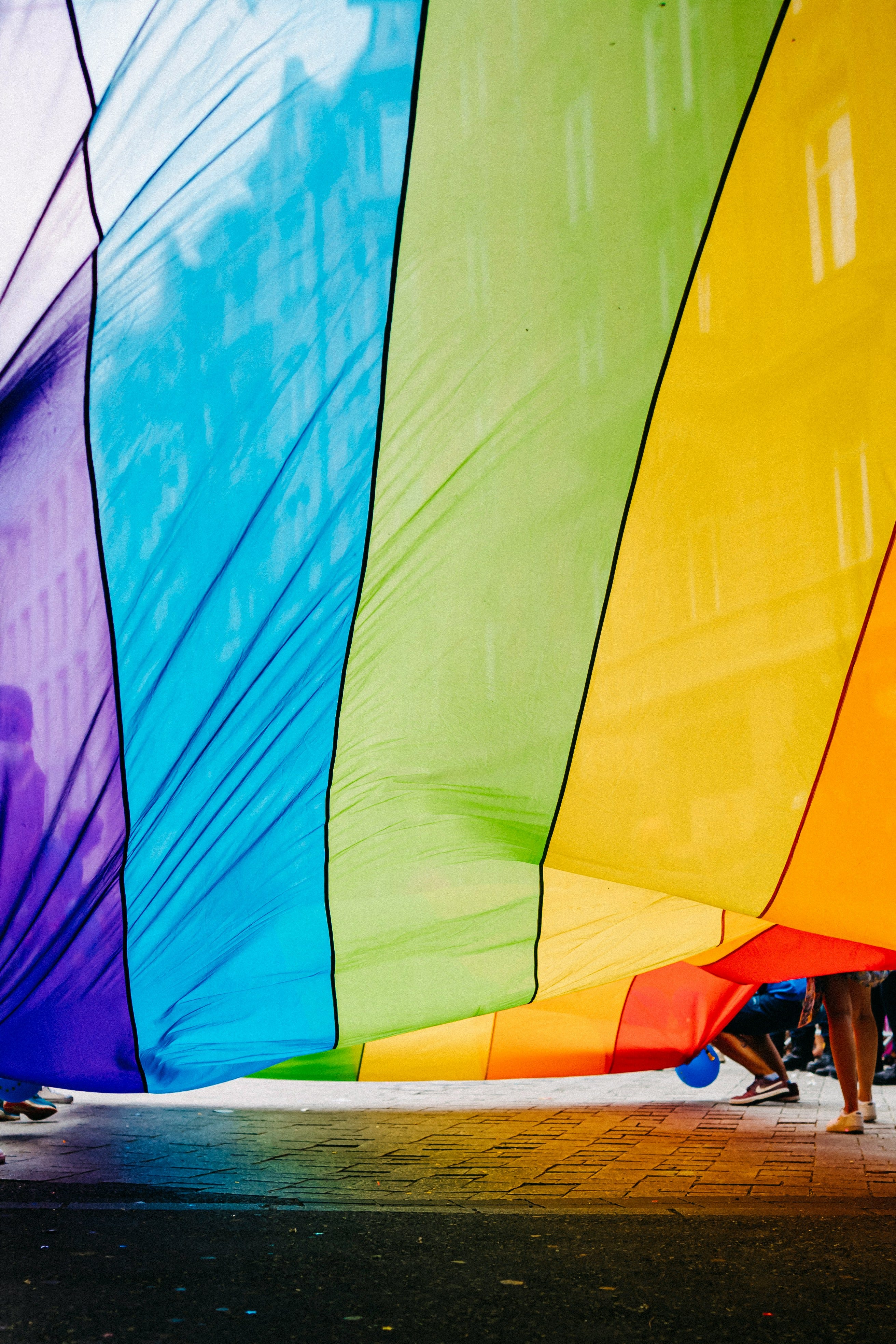
What was attacked at Berlin’s Pride was the prerequisite of love and freedom: safety.
Why it hurts so deeply is because it isn’t an anomaly; this is the fear queer people already live with, and that fear is its own kind of loneliness. Maybe the foundation of anything like oneliness for queer people has to start there, before anything else: with feeling safe enough to stop calculating. That’s something I don’t have to think about in the same way, even though I know what it means to live as a minority, to have faced racism, to carry my own version of vigilance. But not this version. Not the one where the fear is for simply loving who you love, walking where you walk, being who you are in public.
We’ve come further since the 1960s, and yet, on a day like this, it’s difficult not to question that very progress. Nothing will change until we as humans change. So are we truly willing to? To see the lines between those who fight for queer rights and those who march for an end to the Palestinian occupation and genocide, and beyond that, to everyone pushed toward a loneliness so cold and cruel it becomes uninhabitable?
Where in our lives, friendships, (chosen) families, workplaces, neighborhoods, and places we call home can we move from willful indifference, that begins with the tolerance of seemingly insignificant small violent acts against otherness?
Racism within queer spaces, for example, the exclusion of trans women of color, class gatekeeping, and the reproduction of hierarchies still exist. As Kai Cheng Thom argues, community is not a safe refuge by default. It must be actively built, repaired, and chosen again.
This is where the deeper question opens. Queer belonging, real queer belonging, isn’t about acceptance, or fitting into a corner, or being visible within the existing order. It is about what the Cuban-American scholar José Esteban Muñoz calls world-making: the practice of imagining and building relations and forms of life that exceed the limits of the present.
As Jaime Hoerricks, PhD writes:
“Empire is built on discipline, hierarchy, and scarcity—all enforced through violence, whether that violence is visible or carefully concealed beneath bureaucracy. It is a system that demands control: control over land, over bodies, over knowledge, over time itself. It functions by convincing people that its structures are natural, that hierarchy is inevitable, that some must always suffer for others to thrive. Queerness dissolves all of this. Not just by opposing it, but by rendering its entire logic irrelevant.”
What queer people have been building, out of necessity, from what was withheld, is not only a queer story. It’s inching closer to that horizon we share, a map toward a different way of being with each other altogether.
This is ultimately what solidarity is all about. The word comes from the French solidarité, rooted in the Latin solidus — firm, whole, solid. Not just supporting or empathizing with the suffering of others, but understanding that their suffering is mine, and mine is theirs. That is, in the sense of the Zen Buddhist practice of Plum Village, one of the four anchors of true love.
We need structures, rights, and policies that will enable and empower a good life for all. And where we begin, always, is right here. In choosing to look deeply into our own biases, whether it’s against queer folk or queerness, or anyone else we’ve learned to other. Less assuming, more approaching. Not staying silent. Using our words, our voices from our hearts, as imperfect and unpolished as they may be.
And not allowing a day like yesterday to become forgotten, but to remain in its debt, and as a reminder that we need each other, always. That there is no amount of fear and despair too small or too big to carry alone. That what we miss so deeply in this world is already here—us—and yet we lost our ways. That moments like the ones here, standing in a crowd of tears and sunken hearts, are where we soften and fall open, towards life, towards death, and our willingness to change.
Thank you for reading, passing this on to someone, and for sharing your voice, too.
I’m Monika Jiang, reimagining loneliness into oneliness as a way to love, work, and live. If this resonated, the best way to support the work is to subscribe and share it. For speaking, hosting, or bringing Daily Connect to your team, find me and The Oneliness Project on Instagram, LinkedIn, and monikajiang.org.
PS. Thank you to everyone who took time to fill out my recent survey. It was very helpful. I’m taking time over the summer to sit with it all, let it marinate, and see what will emerge next.
So grateful for your perspective and encouragement. We're standing with you and our whole Queer community here in Minneapolis. Sending big hugs.